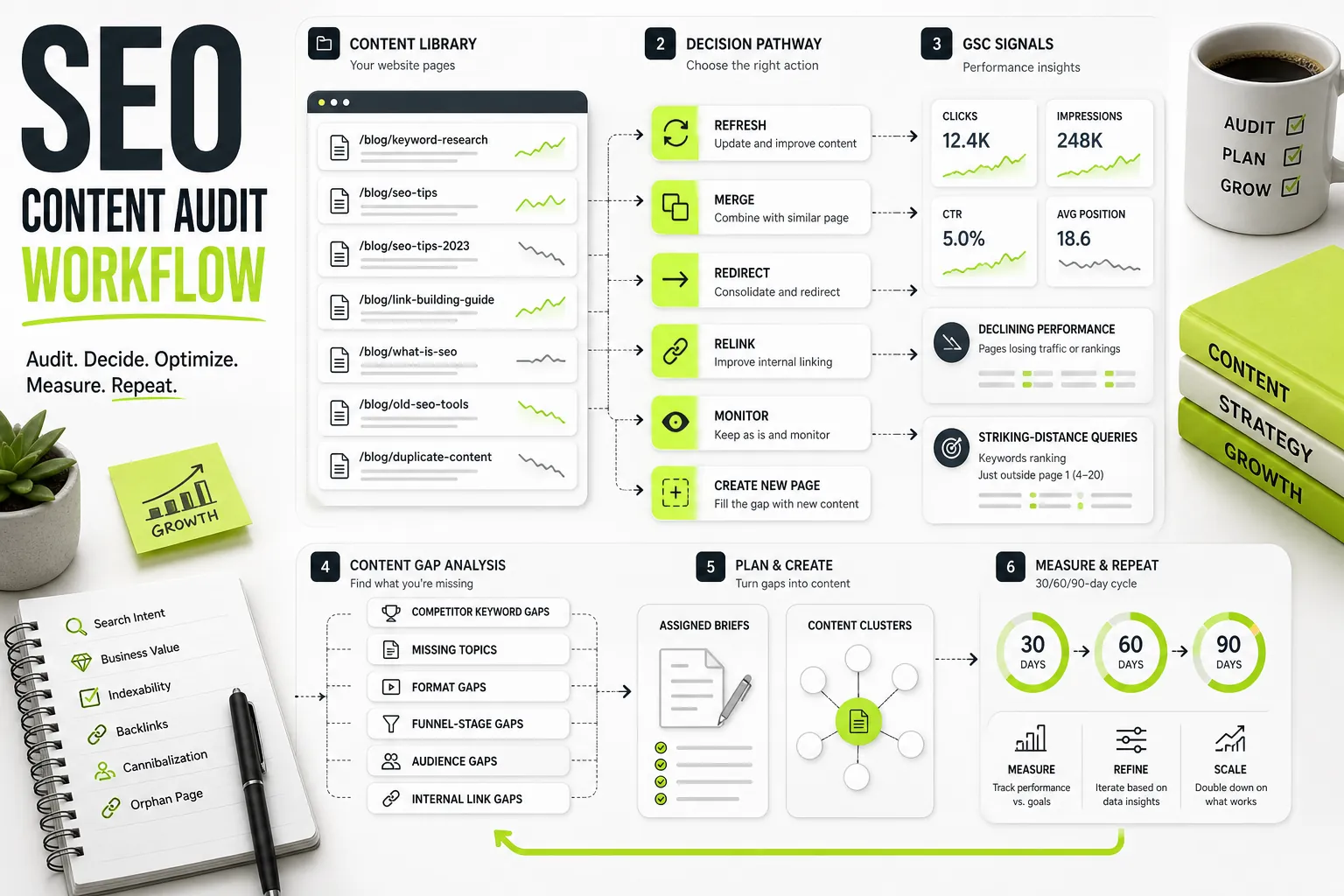
Managing a modern content library requires more than simply publishing new articles every week. Over time, published pages decay, search intent shifts, keyword cannibalization emerges, and unserved topic gaps open up across your buyer’s journey. Without systematic maintenance, organic growth stalls—even if your team continues to produce high-quality material.
Executing a rigorous seo content audit allows you to systematically evaluate every URL on your domain, connect performance metrics with user intent, and determine whether each page should be kept, refreshed, merged, redirected, or removed. This guide walks you through an actionable, data-led framework for conducting a full content audit and gap analysis, turning complex Search Console performance data into clear content directives.
What Is an SEO Content Audit and Why Is It Essential?
Defining the SEO Content Audit Scope
An seo content audit is a comprehensive evaluation of all indexable content published across a domain. Its core objective is to analyze historical search performance, technical page health, on-page content quality, and intent alignment to optimize the domain’s overall organic visibility and conversions.
Rather than viewing pages as static assets, an audit treats every URL as an active component of your search architecture. Through this lens, content auditing helps teams answer critical strategic questions:
- Which legacy assets are losing organic search traffic due to content decay?
- Which pages capture high impression volumes in positions 8–25 (“striking-distance” queries) and need targeted updates to reach page one?
- Where are multiple pages competing against each other for the exact same query, diluting page authority?
- Which published pieces no longer serve buyer intent or contribute to business conversions?
While choosing software for running crawls and consolidating metrics is an important operational step—as outlined in our best content audit tool guide —a tool alone cannot make strategic content decisions. Successful auditing requires a clear decision-making framework that bridges raw metrics with actionable publishing workflows.
SEO Content Audit vs. Technical Audit vs. Content Gap Analysis
Content auditing is often conflated with technical site auditing or competitive keyword research. However, each discipline serves a distinct role in search engine optimization:
| Audit Type | Core Focus | Key Metrics Analyzed | Primary Deliverable |
|---|---|---|---|
| Technical SEO Audit | Crawlability, indexability, site speed, and server health. | HTTP status codes, Core Web Vitals, canonical tags, log files, sitemap errors. | Technical fix list for developers and site architects. |
| SEO Content Audit | Performance, accuracy, freshness, intent fit, and quality of existing published URLs. | Clicks, impressions, CTR, average position, conversions, engagement. | URL-by-URL action matrix (Keep, Refresh, Merge, Redirect, Remove). |
| Content Gap Analysis | Missing topics, subtopics, and intent opportunities unserved by current assets. | Competitor keyword overlaps, missing funnel queries, search intent gaps. | Strategic roadmap for new content creation and expansion. |
A complete growth strategy relies on combining these approaches: first using technical auditing to ensure clean indexation, running an SEO content audit to optimize existing URLs, and then executing a content gap analysis to capture unserved search demand.
Setting Up Your Content Inventory and Spreadsheet Schema
Core Inventory Attributes: Metadata, Topic Clusters, and Ownership
Before evaluating page performance, you must build a clean content inventory. A properly structured inventory aggregates metadata, performance metrics, and content governance attributes into a single source of truth.
Your inventory schema should include the following baseline fields:
[URL] | [Page Title] | [Content Type] | [Topic Cluster] | [Target Intent] | [Publish Date] | [Last Updated] | [Owner] | [Business Value Score]
To maintain long-term alignment across your publishing team, pair your inventory with a structured keyword mapping template . Assigning explicit URL ownership, primary keyword targets, and strategic roles prevents content collision and ensures accountability when assigning post-audit updates.
Connecting First-Party Performance Data from GSC and GA4
First-party data from Google Search Console (GSC) and Google Analytics 4 (GA4) provides the ground truth for page performance. Relying solely on third-party estimate tools can lead to inaccurate audit decisions.
Export and aggregate the following key metrics across multiple timeframes (e.g., trailing 3 months vs. prior 3 months, and trailing 12 months YoY):
- Google Search Console Metrics:
- Clicks: Net traffic driven to the page from search results.
- Impressions: Total exposure in search results for all ranked queries.
- Average CTR: Click-through rate calculated across all impressions.
- Average Position: Mean ranking position across all impressions.
- Google Analytics 4 Metrics:
- Engaged Sessions: Total visitor sessions meeting engagement criteria.
- Key Events / Conversions: Direct sign-ups, lead form submissions, or purchases attributed to the landing page.
- Engagement Rate: Percentage of non-bounce, qualified traffic interactions.
Evaluating business contribution alongside search impressions ensures you do not inadvertently prune low-traffic URLs that drive high-value sales conversions.
Integrating Crawl Data from Screaming Frog or Sitebulb
Supplement performance data by running a site crawl using Screaming Frog SEO Spider or Sitebulb. Connect your crawl tool directly to the Google Search Console and GA4 APIs to automatically map technical status fields alongside performance data.
Key crawl data attributes to import include:
- HTTP Status Code: (e.g., 200, 301, 302, 404)
- Indexability Directive: (Indexable, Non-Indexable, Noindex, Canonicalized)
- Canonical URL: Evaluates canonical mapping targets.
- Inlinks (Internal Links): Count of unique internal links pointing to the page.
- Word Count: Text length depth indicators.
- H1 and Title Tags: Extracted structural metadata for content review.
Analyzing Page-Level SEO Performance and Content Health
Identifying Content Decay and Striking-Distance Keywords (Positions 8–25)
Once your data is consolidated into your spreadsheet schema, run segmented filters to identify operational quick wins and decaying pages.
1. Content Decay Analysis
Content decay occurs when a once-successful page gradually loses traffic and rankings over time due to outdated information, evolving search intent, or new competitor entries.
- Diagnostic Filter: Compare performance over 12 months. Target URLs with a >20% decline in organic clicks and impressions year-over-year despite stable domain authority.
- Action: These assets are primary candidates for a comprehensive content update or structural refresh.
2. Striking-Distance Keyword Opportunities
Striking-distance queries are keywords where a URL ranks between positions 8 and 25. These pages already demonstrate topically relevant signals to Google but lack the structural depth, internal links, or intent alignment required to secure top-tier rankings.
- Diagnostic Filter: Filter GSC query data for pages generating high impression counts (>1,000 monthly impressions) with an average position between 8.0 and 25.0, and a low CTR (<2%).
- Action: Optimizing on-page headings, adding missing subtopics, and injecting targeted internal links can quickly propel these pages onto page one.
| GSC Impressions | Average Position | Average CTR | Audit Classification |
|---|---|---|---|
| > 1,000 / month | 8.0 to 25.0 | < 2.0% | High-Priority Refresh |
| > 5,000 / month | 11.0 to 30.0 | < 1.0% | Consolidation Candidate |
| < 100 / month | > 50.0 | 0.0% | Thin / Prune Evaluation |
Evaluating On-Page Quality, Intent Alignment, and E-E-A-T Signals
Quantitative metrics only reveal what is happening to page traffic; qualitative review reveals why. Review high-priority audit rows against standard search quality guidelines:
- Search Intent Alignment: Does the page serve the exact intent (informational, commercial investigation, transactional, or navigational) expected by current top-ranking results? If search engines now favor concise step-by-step tools or comparison tables, a broad 3,000-word block of text will underperform.
- Information Gain & Depth: Does the article offer original insights, original data, unique visual assets, or expert commentary—or does it simply repeat consensus information from existing search results?
- E-E-A-T Signals (Experience, Expertise, Authoritativeness, Trustworthiness): Are author credentials clearly stated? Are data points supported by authoritative outbound citations? Is product claims evidence verifiable?
- Content Freshness & Accuracy: Are statistics, screenshots, tool recommendations, and referenced year dates completely current?
Checking Technical Health: Indexability, Core Web Vitals, and Canonicals
A content piece cannot perform if technical bottlenecks impede crawling, rendering, or indexing. Verify the technical execution of each audited page:
- Indexability Directives: Ensure high-value pages are marked
index, followand are not restricted byrobots.txtdisallow rules or roguenoindexheaders. - Canonical Mapping: Verify that the canonical tag points to the self-referencing canonical URL unless the page is intentionally a duplicate variant.
- Core Web Vitals (CWV): Inspect performance metrics—specifically Largest Contentful Paint (LCP), Interaction to Next Paint (INP), and Cumulative Layout Shift (CLS). Pages with severe performance lag suffer degraded user experience, lowering engagement metrics.
Diagnosing Cannibalization, Thin Content, and Architecture Issues
Detecting Keyword Cannibalization and URL Overlap
Keyword cannibalization occurs when multiple URLs on the same domain compete for identical or closely overlapping search queries. This splits page equity, internal anchor text value, and external backlinks across several pages, leaving search engines unable to determine which URL best answers the search query.
How to Detect Cannibalization in Search Console
- Export GSC performance reports filtered by a specific primary query.
- Inspect the Pages tab for that query.
- If two or more URLs share significant impressions and split clicks for the exact same target phrase over a 90-day window, cannibalization is present.
Example Cannibalization Pattern:
- Query: “best content audit workflow”
- URL A (
/blog/content-audit-guide): Impressions: 12,400; Clicks: 140; Avg Pos: 11.2 - URL B (
/blog/how-to-audit-website): Impressions: 10,100; Clicks: 110; Avg Pos: 13.8
Resolution: Merge the unique insights from both pages into a single, comprehensive asset on the stronger URL, then implement a 301 redirect from the weaker page to the primary URL.
Uncovering Orphan Pages and Internal Link Deficits
Internal link distribution directly impacts how search crawlers discover, index, and weigh the relative importance of your pages.
- Orphan Pages: URLs that are indexable and return an HTTP 200 status code, but have zero internal links pointing to them from other pages on your domain. Orphan pages struggle to gain ranking authority and waste crawl budget.
- Internal Link Deficits: High-value or striking-distance pages that receive fewer than 3 to 5 internal links from topically relevant context pages.
To streamline the identification of orphan assets, anchor opportunities, and link distribution bottlenecks across your architecture, review our internal linking tool guide .
Conducting an SEO Content Gap Analysis
Executing an seo content gap analysis enables you to systematically map unserved market demand, discover topics competitors cover that your site misses, and pinpoint gaps within your existing content funnel.
Cross-Referencing Competitor Research with GSC Queries
While standard content auditing evaluates pages you currently host, an seo content gap analysis moves beyond owned inventory to examine competitive market potential.
The Content Gap Workflow:
- Gather Third-Party Competitor Data: Use competitive intelligence tools (such as Ahrefs or Semrush) to extract domain-level keyword gaps—queries where top competitors rank in the top 10, but your domain does not rank in the top 100.
- Cross-Reference First-Party GSC Data: Filter competitor keyword suggestions against your site’s actual GSC query logs.
- If GSC shows your site already receives impressions for a keyword, it is not a missing-topic gap; it is an existing page optimization target.
- If GSC confirms zero historical impressions for a high-intent query cluster, it represents a genuine new content gap.
For detailed instructions on combining third-party software extracts with Search Console query validation, follow our comprehensive keyword gap analysis guide .
Classifying Gaps by Topic, Intent, Format, and Funnel Stage
Avoid treating every content gap as a directive to write a basic blog post. Categorize discovered gaps across six specific structural dimensions:
| Gap Category | Description & Example |
|---|---|
| 1. Topic Gap | Entire core entities or subtopics completely absent from the site. |
| 2. Search Intent Gap | Content exists, but matches the wrong intent (e.g., blog vs. tool page). |
| 3. Format Gap | Audience requires a calculator, template, or visual table, not text. |
| 4. Funnel Stage Gap | Excessive top-of-funnel guide posts; zero bottom-of-funnel comparisons. |
| 5. Audience Gap | Coverage targets beginners, leaving enterprise or technical personas out. |
| 6. Architecture Gap | Pages exist in isolation without supporting pillar-cluster links. |
Auditing for AI Search Visibility and Generative Citations
Evaluating Entity Clarity and Brand Mentions in AI Overviews
Modern search engines increasingly summarize answers directly within AI-generated search overviews and conversational interfaces. Auditing for AI search visibility requires evaluating how effectively search algorithms extract, attribute, and cite your brand as an authoritative entity.
Unlike traditional organic rank tracking—which measures position links on a search results page—AI visibility relies on structured entity clarity, clear topical relationships, and succinct textual answers.
Strategic Evaluation Checklist for AI Search Overviews:
- Entity Definition: Does the target page include concise, unambiguous summary definitions within the lead paragraph?
- Structured Information Layout: Are core steps, comparison factors, and technical specs presented using logical HTML subheadings (
<h2>,<h3>), ordered lists, and concise tables? - Direct Answer Formatting: Are key conversational queries answered concisely within 40–60 words directly beneath matching heading text?
- Brand Citation Context: Does your site hold primary authority or attribution citations across third-party expert industry publications?
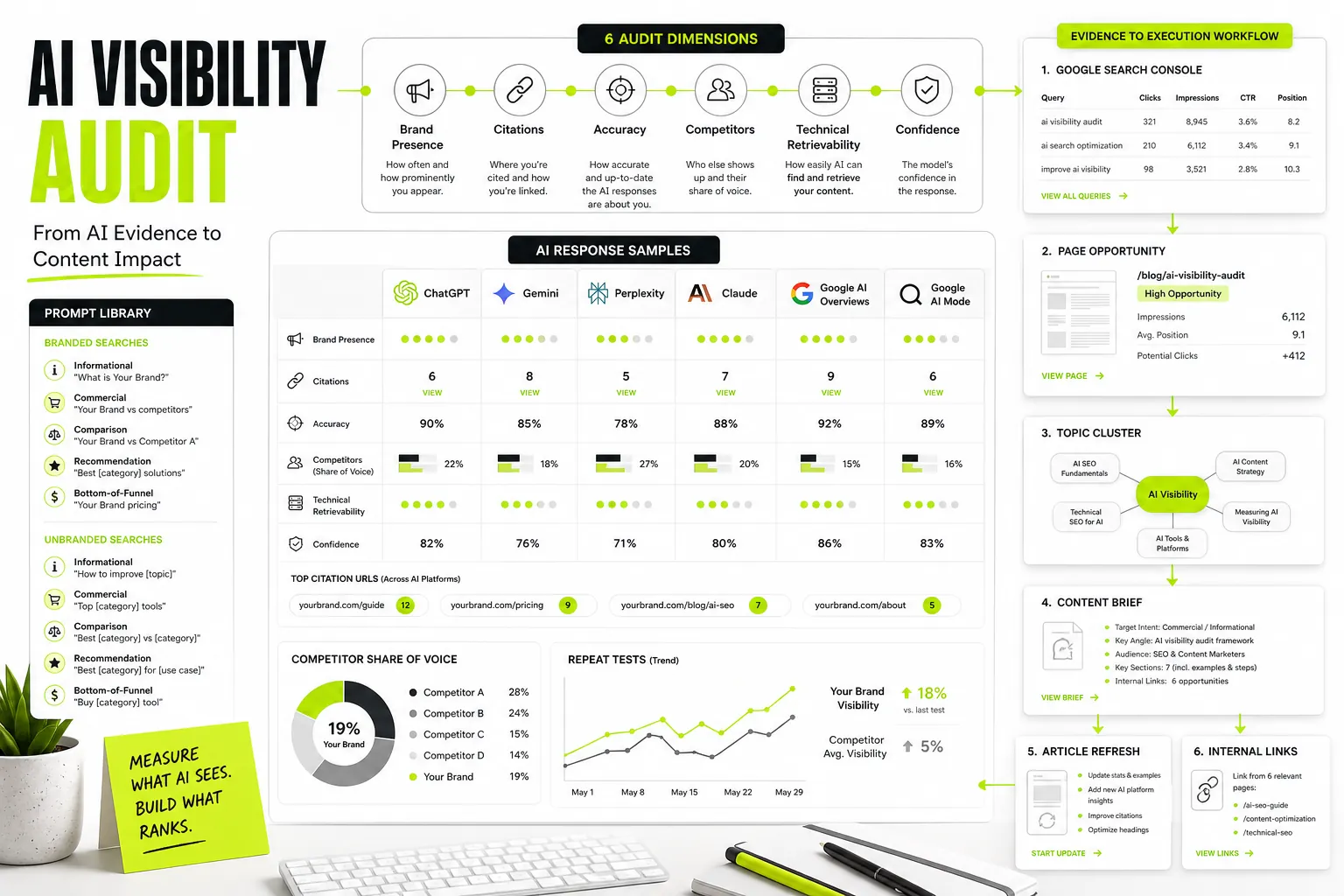
If your domain relies on organic discovery for technical or commercial queries, layer an explicit AI visibility audit onto your standard content evaluation framework to optimize for conversational citations alongside classic organic rankings.
The Action Matrix: Categorizing and Prioritizing URL Decisions
Applying Content Directives: Keep, Refresh, Merge, Redirect, or Remove
Every URL evaluated during an SEO content audit must be assigned an explicit operational directive. Use the following decision tree to standardize your team’s workflow:
- If organic clicks and conversions are stable:
- High traffic: Keep the URL and maintain and protect it.
- Low traffic: Monitor performance over 90 days.
- If organic clicks and impressions are down:
- Content is outdated or ranks within striking distance: Refresh the page by updating and expanding it.
- Content is thin, duplicate, or has zero search intent: Merge / Redirect to consolidate equity.
- Keep: URL meets traffic, keyword position, and conversion benchmarks. No structural content updates required. Maintain page monitor.
- Refresh / Rewrite: URL exhibits high impression counts or declining traffic, but retains topical authority. Update outdated stats, add missing subtopics, align with current search intent, and strengthen internal linking.
- Merge (Consolidate): Multiple pages cannibalize the same query cluster or cover thin, overlapping subtopics. Consolidate valuable content into the best-performing URL, then 301-redirect the secondary URLs.
- Redirect (Prune): Page generates no search impressions, holds no backlinks, and drives no business value, but sits on an obsolete URL path. Redirect to the most topically relevant parent category or primary pillar page.
- Remove (410 / Delete): Page provides zero user value, targets obsolete search queries, holds zero external links or engagement, and has no logical redirect target. Set status code to 410 (Gone) or 404 to save crawl budget.
Scoring Impact vs. Effort with a Prioritization Formula
To turn audit rows into a practical roadmap, apply a standardized scoring formula that weights potential search impact against required production effort.
Priority Score: Multiply GSC impression potential by the Business Value Rating (1–5), then divide the result by the Production Effort Rating (1–5).
Sample Content Audit Scoring Spreadsheet Row:
| URL Path | Target Keyword | GSC Impressions | Position | Action | Business Score | Effort Score | Priority Score |
|---|---|---|---|---|---|---|---|
/blog/seo-audit-checklist | seo content audit | 14,200 | 14.2 | Refresh | 5 | 2 | 35.5 |
/blog/old-seo-tips-2019 | search tips | 350 | 48.0 | Redirect | 1 | 1 | 3.5 |
/blog/content-audit-tools | content audit tool | 8,900 | 18.5 | Merge | 4 | 3 | 11.8 |
Post-Audit Execution and Measuring 30/60/90-Day Results
Converting Audit Findings into Content Briefs and Internal Linking Tasks
An SEO content audit only delivers business impact when recommendations are systematically executed. Convert audit spreadsheet directives into actionable task tickets:
- Build Content Update Briefs: For pages marked for a Refresh or Merge, outline explicit brief updates:
- Target primary and striking-distance search queries.
- Required content additions, missing subtopics, and visual table assets.
- On-page heading structure (
<h2>/<h3>) updates. - Directives for canonical tags and 301 redirects.
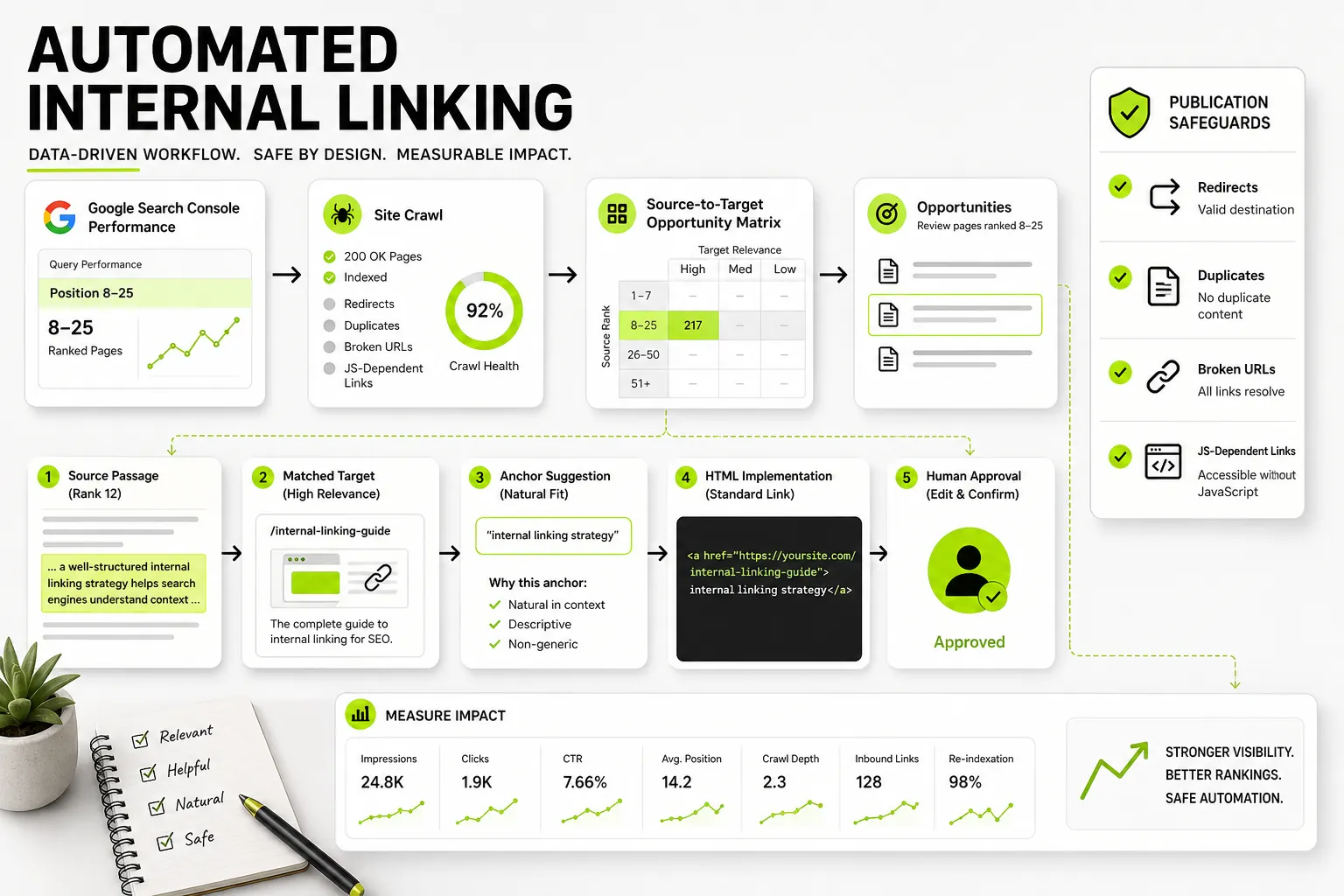
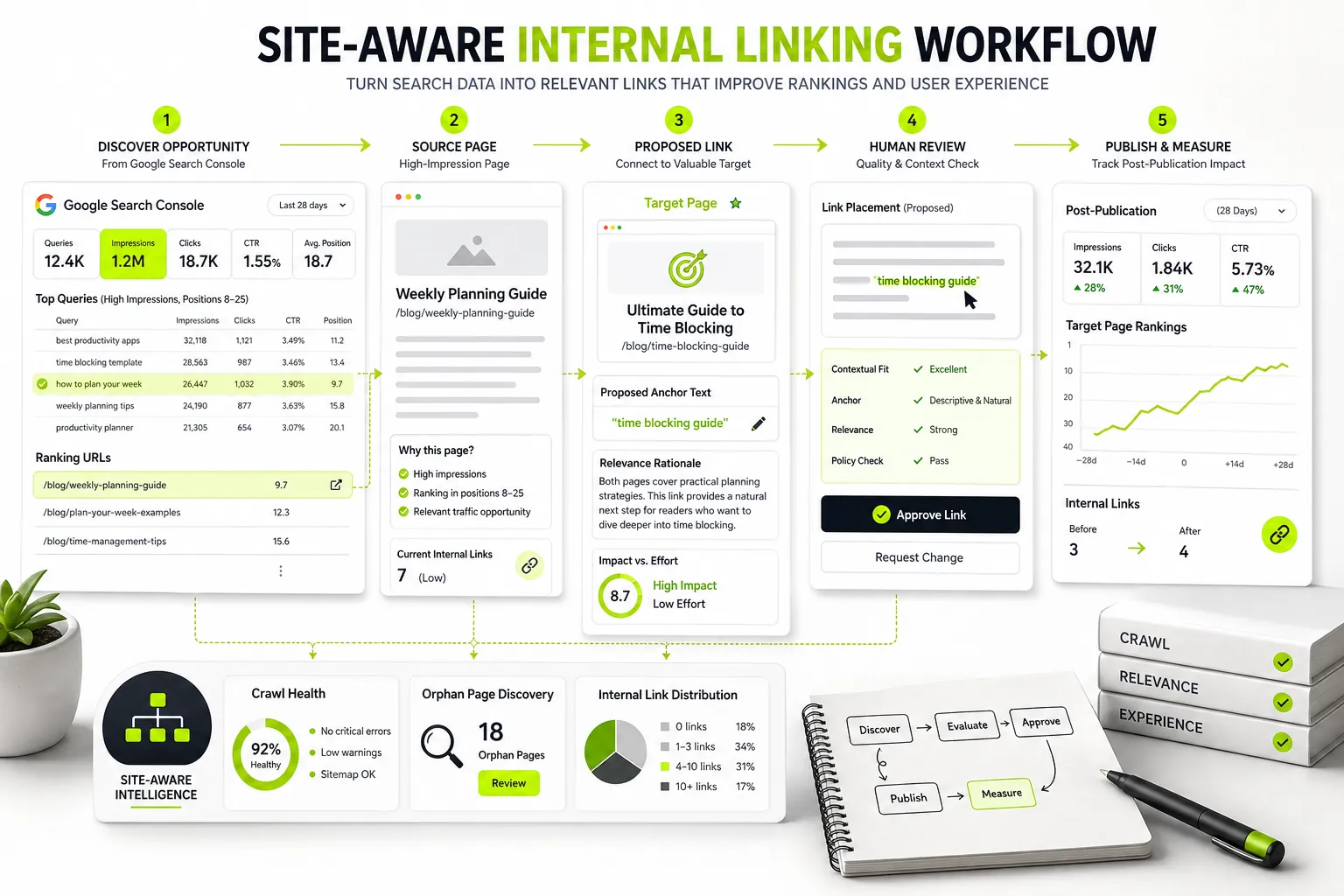
- Execute Targeted Internal Link Distribution: Build a dedicated internal link implementation queue. Add relevant contextual links from high-authority, high-traffic pages pointing directly to updated striking-distance URLs. Review our internal linking tool guide for instructions on automating context matching and anchor text selection.
Accelerating Post-Audit Workflows with Dango
Converting complex Google Search Console performance extracts into optimized briefs, clustered topics, and published refreshes can quickly create production bottlenecks when managed manually in spreadsheets.
Dango is an AI-powered SEO platform designed specifically around Google Search Console and sitemap data. Instead of requiring manual CSV exports and VLOOKUP equations, Dango connects directly to your search performance data to convert high-impression queries and striking-distance opportunities into structured keyword clusters, content briefs, optimized articles, and automated internal link assignments.
If your team manages a growing content library and wants to streamline post-audit updates, see how Dango works —with professional plans starting at 99/month for Starter and 299/month for Professional tiers.
Tracking Performance Recovery and Growth Cadence
Establish a structured 30/60/90-day measurement cadence to track search index re-evaluations and performance recovery following an audit deployment:
| Timeframe | Core Milestones & Performance Checkpoints |
|---|---|
| Day 1 – 30 | Verify 301 redirects and 410 status codes in GSC; submit updated XML sitemaps for accelerated recrawling; audit initial indexing status of refreshed assets. |
| Day 31 – 60 | Inspect striking-distance movement for updated URLs; monitor CTR adjustments on updated titles and descriptions; confirm cannibalization resolution on merged URL pairs. |
| Day 61 – 90 | Measure net organic click and conversion growth YoY; re-run content gap analysis against updated search ranks; finalize baseline metrics for next quarter’s maintenance. |
Frequently Asked Questions About SEO Content Audits
How often should you perform a full SEO content audit?
For most active blogs and publishing domains, a comprehensive SEO content audit should be executed annually. However, high-velocity sites publishing dozens of assets monthly benefit from lighter quarterly delta audits that specifically check for content decay, striking-distance updates, and keyword cannibalization.
What is the difference between content decay and keyword cannibalization?
Content decay occurs when a single page loses ranking position and search traffic over time because its information is outdated or competitors published superior coverage. Keyword cannibalization occurs when two or more pages on your own site compete against each other for the exact same search query, diluting ranking equity across multiple URLs.
How do you determine whether to update, merge, or delete a URL?
Update a URL if it targets a clear search query, holds historical topical authority, but requires fresh information or better intent alignment. Merge two URLs if they compete for the same query cluster or cover thin, overlapping topics. Delete (or redirect) a URL if it generates zero search traffic, offers no business or backlink value, and targets obsolete queries with no search demand.
Should you redirect deleted pages during a content pruning campaign?
Yes, provided a topically relevant parent page or substitute asset exists. Implementing a 301 redirect passes existing link equity to the destination URL. If no relevant alternative page exists on your site, set the HTTP status code to 410 (Gone) so search engines quickly remove the obsolete URL from their indexes.
How does an SEO content audit improve rankings in AI Search Overviews?
An SEO content audit identifies structurally cluttered pages and refactors them into clear, entity-focused answers. By updating heading hierarchies, summarizing key definitions, and presenting comparisons in structured lists and tables, your content becomes significantly easier for generative search engines to parse and cite in AI Overviews.