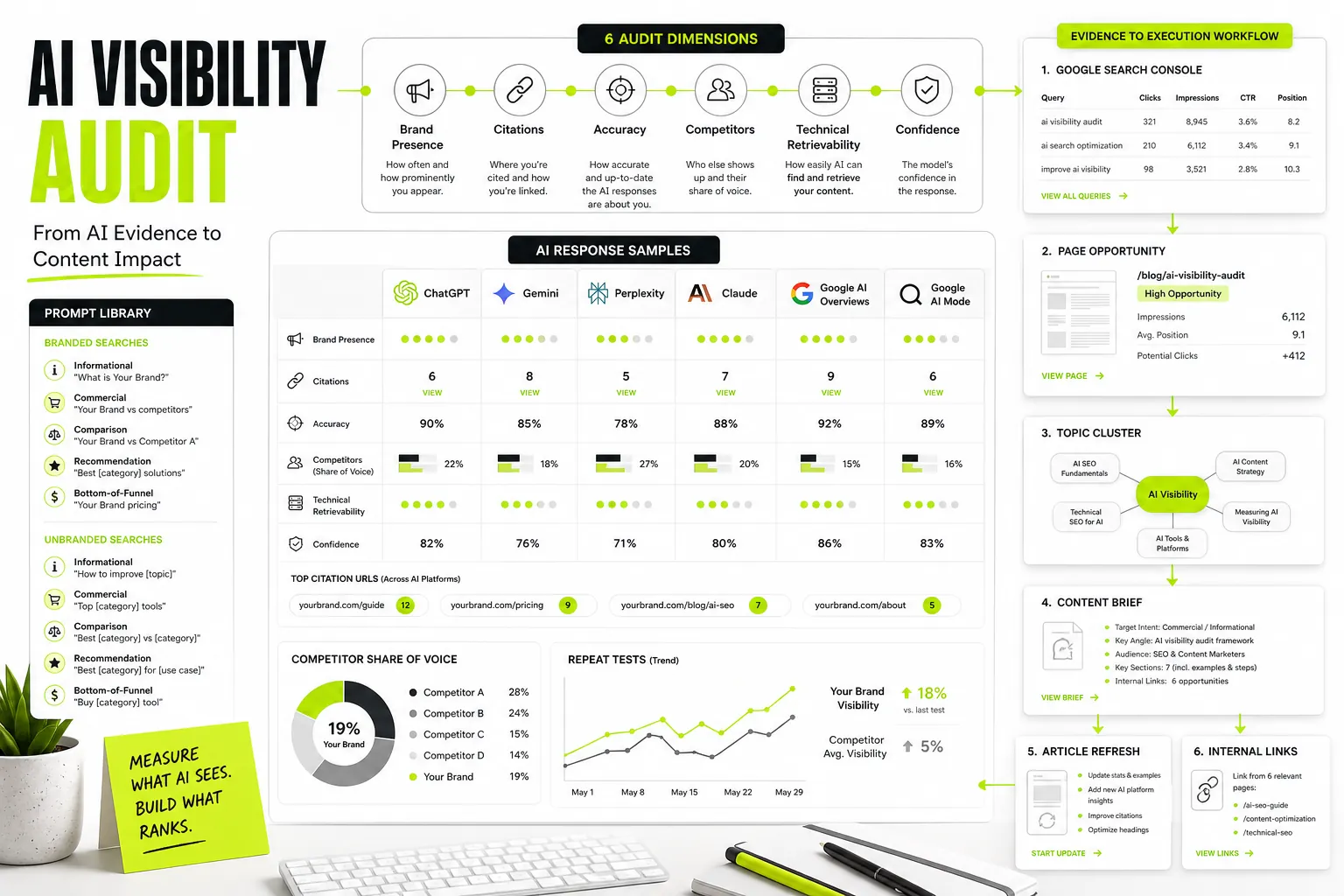
As generative answer engines replace conventional search engine results pages (SERPs) for informational and commercial research, evaluating search performance requires a fundamentally different diagnostic toolkit. Performing an ai visibility audit allows marketing teams to measure how artificial intelligence platforms synthesize brand information, attribute source URLs, frame product recommendations, and present category choices to prospects.
Unlike legacy rank-tracking systems that evaluate stable ten-blue-link listings, answer engine visibility operates in a non-deterministic, probabilistic environment. Models generate direct responses using internal model weights, web browsing, and Retrieval-Augmented Generation (RAG).
This guide outlines a tool-agnostic, reproducible AI visibility audit framework. It covers prompt engineering for testing, statistical variability controls, a transparent six-dimension scoring model, competitor share-of-voice calculations, and an actionable decision matrix. It also explains how to validate AI search insights against real performance data in Google Search Console (GSC).
What Is an AI Visibility Audit? (And How It Differs from SEO)
An AI visibility audit is a systematic diagnostic process that evaluates how frequently, accurately, and prominently a brand or web property appears in answers generated by Large Language Model (LLM) answer engines.
- Prompt Library Construction: ToFu, MoFu, BoFu, and branded prompts.
- Multi-Engine Response Sampling: ChatGPT, Gemini, Perplexity, and other engines.
- Multi-Run Repeat Sampling: Calculate variance and confidence.
- Data Extraction: Mentions, citations, sentiment, and accuracy.
- Technical and Entity Retrievability QA: Robots directives, schema, and canonicals.
- Six-Dimension Scoring and Competitor Share of Model Voice (SoMV).
- GSC Diagnostics and Decision Matrix: Refresh, create, or monitor.
Rather than tracking fixed rankings for static keywords, an AI visibility audit treats answer engines as dynamic synthesis tools. It measures model outputs across hundreds of query variations, tracks cited reference links, audits technical retrievability for AI crawlers, and evaluates entity clarity.
Defining AI Search Visibility Across Answer Engines
AI search visibility measures a brand’s presence across the full spectrum of generative answer engines. It evaluates whether an engine:
- Mentions the brand by name when answering category-level discovery prompts.
- Cites owned domain URLs as authoritative references or grounding sources.
- Recommends the brand’s products or services over competitors for commercial intent prompts.
- Expresses accurate, up-to-date details regarding pricing, features, capabilities, and positioning.
Because platforms like ChatGPT, Perplexity, Google AI Overviews, Claude, and Gemini retrieve and summarize information differently, visibility varies substantially across surfaces. A brand might dominate Perplexity citations due to structured documentation while remaining completely absent from ChatGPT recommendations due to outdated training weights or sparse entity mentions across third-party review sources.
Key Differences: Traditional SEO Audit vs. AI Visibility Audit vs. GEO
Understanding where an AI visibility audit fits alongside traditional search and generative engine optimization (GEO) requires separating discovery mechanics from remediation tactics.
| Audit Dimension | Traditional SEO Audit | AI Visibility Audit | Generative Engine Optimization (GEO) |
|---|---|---|---|
| Primary Metric | Keyword positions, organic traffic, backlink counts, technical site health | Brand presence rate, citation share, answer prominence, entity accuracy | Citation growth, model recommendation rates, inclusion in generated lists |
| Data Source | SERP HTML, crawler logs, Google Search Console, rank-tracking APIs | Non-deterministic model responses, RAG citation outputs, AI crawler directives | Experimental content variations, entity schema, off-page citations |
| Primary Focus | Page-level ranking factors, crawl budget, backlink authority, title tags | Model knowledge presence, source attribution, dynamic synthesis, RAG retrievability | Crafting content structures optimized for LLM extraction and citation |
| Scope | Owned domain infrastructure and SERP positioning | Multi-surface model outputs, third-party sentiment, multi-turn prompt fan-out | On-page structure, clear entity statements, digital PR, third-party consensus |
While a traditional site audit in Google Search Console focuses on indexing, crawl errors, click-through rates, and organic keyword positions, an AI visibility audit measures how models interpret and summarize your brand’s topic footprint across the web. GEO, by contrast, refers to the post-audit execution strategy—optimizing content and entities to earn citations.
Why Standard Rank Trackers Miss AI Engine Mentions
Standard rank trackers query conventional search engine result pages and parse DOM elements (such as <h3> tags or clean <a> href links) to calculate numerical positions from 1 to 100. This methodology breaks down when applied to generative answer engines for three core reasons:
- Non-Deterministic Outputs: LLMs rely on probabilistic token prediction. Requesting the exact same prompt five times across five clean sessions can yield five distinct text responses, varying source citations, and fluctuating product placement order.
- Absence of Uniform SERP Positions: Answers appear as synthesized prose, bulleted lists, comparison tables, or interactive callouts rather than ordered link lists. Position #1 in a generated text response carries a completely different intent context than position #1 in Google organic search.
- Retrieval-Augmented Generation (RAG) Dynamics: Answer engines do not rank pages based purely on page-level backlink formulas. They retrieve content chunks from vector stores, filter results based on real-time sub-query fan-out, and synthesize answers from multiple competing sites in a single sentence.
Selecting Test Surfaces and Managing Response Variability
An effective audit protocol requires testing across the primary AI answer surfaces while implementing strict controls for model non-determinism.
Coverage Across ChatGPT, Gemini, Perplexity, Claude, and Google AI Overviews
A thorough audit evaluates brand presence across five distinct answer engine architectures:
- ChatGPT (OpenAI): Evaluates web-browsing search behavior, model weights, and custom GPT knowledge retrieval. Focuses on broad consumer and enterprise commercial recommendation queries.
- Gemini (Google): Evaluates Google’s native multimodal LLM, drawing heavily from Google’s Knowledge Graph, top-ranking organic web pages, and real-time Search index integrations.
- Perplexity AI: Operates primarily as an explicit RAG engine. Emphasizes live web index retrieval, precise inline citation links, and domain source diversity.
- Claude (Anthropic): Tests underlying parametric knowledge, reasoning capabilities, and document synthesis when connected to web search tools.
- Google AI Overviews & Google AI Mode: Analyzes generative answer cards injected directly into Google SERPs. For a detailed breakdown of multi-turn query expansion, citation rendering, and diagnostic workflows specifically tailored to Google’s next-generation interface, see our guide on AI Mode SEO .
Managing Sampling Bias, Personalization, and Model Updates
To produce reliable data, audit procedures must minimize environmental variables that skew model responses:
- Session Isolation: Always execute test prompts using clean API calls or isolated, incognito browser sessions with zero prior conversation history to prevent conversational context bias.
- Geographic Standardizing: Use localized proxy environments or explicit location parameters within API configurations to control for regional RAG index selection.
- System Settings Standardizing: When auditing via web interfaces, maintain default model settings (e.g., standard browsing modes without custom user instructions or personalized memory profiles enabled).
- Version Logging: Record the precise model deployment version (e.g.,
gpt-4o-2024-08-06,gemini-1.5-pro,perplexity-sonar-huge) and execution timestamp for every audit run, as back-end system updates occur continuously.
Repeat-Testing Methodology and Statistical Confidence Limits
Single-run prompt testing generates anecdotal noise rather than actionable business intelligence. Because model temperature parameters introduce response variation, an audit framework must enforce a N=5 repeat-run methodology for core commercial prompts.
To measure response stability, calculate the Citation Consistency Index (CCI) across test runs:
Citation Consistency Index (CCI): Divide the number of runs that cite the brand URL by the total number of runs executed, such as five, then multiply by 100.
- High Stability (80%–100%): The brand is persistently embedded in the model’s RAG retrieval set or primary parametric knowledge.
- Moderate Stability (40%–60%): The brand sits on the boundary of retrieval cutoff; minor shifts in sub-query fan-out alter inclusion.
- Low/Unstable (1%–20%): The brand is occasionally retrieved due to random token variation, indicating weak entity association.
Stage 1: Building a Representative Prompt Library
An audit’s accuracy depends directly on prompt library construction. Rather than relying on simple seed keywords, audit prompts must replicate natural user queries, dynamic search behaviors, and full-funnel research patterns.
Categorizing Prompts by Search Intent: Informational, Comparison, and Bottom-of-Funnel
Build a prompt library structured across four clear intent categories, sampling 20 to 50 prompts per tier depending on brand size:
| Intent category | Example prompts |
|---|---|
| Top-of-Funnel (ToFu): Informational and concepts | ”What is an AI visibility audit?”; “How does RAG retrieval work in search?” |
| Mid-Funnel (MoFu): Methodology and evaluation | ”How to track brand presence in ChatGPT?”; “Best practices for schema markup in AEO” |
| Bottom-of-Funnel (BoFu): Commercial recommendation | ”Best enterprise AEO tools for SaaS”; “Top platform for GSC topic clustering” |
| Head-to-Head Comparison: Direct alternatives | ”Brand A vs Brand B platform pricing”; “Top alternatives to Brand X for SEO” |
Mapping Branded vs. Unbranded Discovery Queries
Separate your prompt testing matrix into two core query classes:
- Unbranded Discovery Queries: These assess market share of voice and category ownership (e.g., “What are the top content cluster generation platforms for SaaS teams?”). The objective is measuring whether the model introduces your brand organically alongside established category leaders.
- Branded Fact-Checking & Sentiment Queries: These assess knowledge graph accuracy and reputation management (e.g., “What are the main features, pricing tiers, and integration limits of [Brand Name]?”). The objective is uncovering hallucinated limitations, incorrect pricing, or negative answer framing.
Query Fan-Out, Sub-Prompts, and RAG Retrieval Patterns
Modern answer engines do not search the web using a user’s exact raw prompt. Instead, they execute query fan-out—breaking complex prompts into multiple localized sub-queries run simultaneously against search indexes.
For example, a user prompt like “Recommend an enterprise SEO platform with automated GSC keyword clustering” triggers the following background RAG sub-queries:
- Sub-query 1:
enterprise SEO software GSC integration - Sub-query 2:
best automated keyword clustering tools - Sub-query 3:
top platform topic clustering Google Search Console
During Stage 1, record observed query fan-out sub-queries (visible in engines like Perplexity or Google AI Overviews). This reveals the intermediate search queries your site must capture to be included in the synthesized final output.
Stage 2: Measuring Brand Presence, Citations, and Sentiment
Once response data is logged, audit team members evaluate outputs across qualitative and quantitative metrics.
Calculating Brand Presence Rate and Prominence Scores
Evaluate two core quantitative metrics for every prompt category across engines:
1. Brand Presence Rate (BPR)
The percentage of total test runs in which the brand is explicitly mentioned in the text body:
Brand Presence Rate (BPR): Divide the total prompt runs that mention the brand by the total prompt runs executed, then multiply by 100.
2. Answer Prominence Score (APS)
A weighted metric (0 to 100) reflecting where and how the brand appears within the answer text:
- Tier 1 (100 Points): Primary recommendation; listed first or explicitly highlighted as top choice.
- Tier 2 (70 Points): Secondary mention; included inside a multi-brand list or comparison table.
- Tier 3 (30 Points): Caveat or peripheral mention (e.g., “Brand X is an option, but lacks enterprise features”).
- Tier 4 (0 Points): Complete omission from generated text.
Citation Analysis: Categorizing Sources, Domain Authority, and Links
Answer engines validate their text outputs using inline link citations. In this stage, capture every cited URL and categorize it by source type:
| Source category | Description |
|---|---|
| Owned Domain | Direct links to blog posts, documentation, and product pages. |
| Third-Party Reviews | G2, Capterra, Trustradius, and Gartner. |
| Industry Publications | Search Engine Land, TechCrunch, and blogs. |
| User-Generated Content (UGC) | Reddit threads, Quora answers, and forums. |
| Aggregator or Listicle | ”Top 10 Tools” roundup posts and directories. |
Audit whether the model cites your owned domain directly or relies entirely on third-party consensus to corroborate your existence. If an engine mentions your brand positively but cites a competitor’s roundup post or an outdated G2 review page instead of your dedicated product landing page, your on-page entity signals or technical retrievability require remediation.
For a detailed methodology on measuring RAG retrieval accuracy, source attribution, and entity verification, consult our complete guide on grounding AI for SEO .
Sentiment, Answer Framing, and Hallucinated Product Details
In addition to citations, audit the sentiment and accuracy of the generated text:
- Sentiment Framing: Is the brand framed as a modern market leader, a high-priced enterprise option, or an outdated legacy tool?
- Product Feature Accuracy: Does the model claim your software lacks features that actually exist in your product?
- Pricing & Tier Accuracy: Are free plans, starting prices, or legacy package details hallucinated or obsolete?
Document all hallucinated claims in a central QA log to prioritize entity grounding work.
Stage 3: Technical Retrievability and AI Crawler Governance
Generative models rely on web scrapers and specialized user-agents to feed real-time RAG pipelines and model fine-tuning indexes. Technical retrievability ensures these bots can crawl, render, and extract page contents cleanly.
AI Crawler Directives: Managing GPTBot, PerplexityBot, and Google-Extended
Review your robots.txt configuration to verify crawler directives align intentionally with your business model:
      # Example AI Crawler Directives Governance Matrix
User-agent: GPTBot
Disallow: /private/   # Allow public access for ChatGPT training/search

User-agent: ChatGPT-User
Allow: /              # Essential for live real-time ChatGPT web browsing

User-agent: PerplexityBot
Allow: /              # Essential for Perplexity live search & inline citations

User-agent: ClaudeBot
Allow: /              # Allows Anthropic RAG indexing

User-agent: Google-Extended
Disallow:             # Controls Google AI training usage (separate from Googlebot)
"Crucial Distinction: Blocking
GPTBotprevents OpenAI from using site data for future model training, but blockingChatGPT-UserorPerplexityBotbreaks live user-driven web search browsing—instantly removing your site from real-time citations.
Crawlability, Rendered HTML, and Canonical Integrity
AI search crawlers often use lightweight rendering engines to maximize fetching speed. Ensure your core content is retrievable without heavy client-side JavaScript execution:
- Server-Side Rendering (SSR) / Static HTML: Ensure critical content definitions, product comparison tables, and key data points exist in raw server-rendered HTML rather than requiring client-side JavaScript execution.
- Clean Canonical Tags: Verify self-referential canonical tags point to clean URLs. AI scrapers following redirected canonical chains often drop secondary pages from RAG vector stores.
- Unrestricted Paywalls / Gating: Ensure ungated content contains clear, indexable textual content rather than obfuscated DOM nodes or modal overlays that block scraper parsing.
Structured Data and Entity Readiness: Schema for Organization, FAQ, and Product
Structured JSON-LD schema acts as explicit data grounding for LLMs, removing ambiguity during token parsing. Audit site-wide implementation for these essential schema types:
      {
  "@context": "https://schema.org",
  "@graph": [
    {
      "@type": "Organization",
      "@id": "https://dango.sh/#organization",
      "name": "Dango",
      "url": "https://dango.sh/",
      "logo": "https://dango.sh/logo.png",
      "sameAs": [
        "https://twitter.com/dangosh",
        "https://www.linkedin.com/company/dangosh"
      ],
      "description": "GSC-first topic clustering and content production workflow platform."
    },
    {
      "@type": "SoftwareApplication",
      "name": "Dango Content Workflow",
      "applicationCategory": "SEO Software",
      "operatingSystem": "Web",
      "offers": {
        "@type": "AggregateOffer",
        "priceCurrency": "USD",
        "lowPrice": "99",
        "highPrice": "299"
      }
    }
  ]
}
Verify that Organization, Article, WebPage, BreadcrumbList, FAQPage, and Product schemas are validated using Google’s Rich Results Test tool without missing required fields.
Stage 4: Competitor Benchmarking and Share of Voice
An AI visibility score gains strategic value when measured relative to direct market competitors across the exact same prompt library.
Benchmarking Share of Model Voice Against Direct Competitors
To compute Share of Model Voice (SoMV), aggregate the total brand mentions generated across your entire test prompt library for all category players:
Share of Model Voice (SoMV): Divide total mentions of your brand by total category mentions across all competitors and your brand, then multiply by 100.
Example Benchmark Scenario (50 Target Prompts Across 4 Engines = 200 Total Runs)
| Brand | Mentions | Share of Voice |
|---|---|---|
| Competitor A | 82 | 39.0% (Market Leader) |
| Your Brand | 54 | 25.7% (Challenger) |
| Competitor B | 41 | 19.5% |
| Competitor C | 33 | 15.8% |
| Total Category Mentions | 210 |
In this scenario, your brand holds a 25.7% Share of Model Voice. Comparing this against organic SERP market share highlights whether your brand is overperforming or underperforming in AI search channels.
Identifying Competitor Source Dominance and Citation Gaps
Analyze the third-party websites cited when competitors are mentioned instead of your brand. Create a Citation Gap Matrix:
| Cited Domain | Source Category | Cites Competitor A? | Cites Competitor B? | Cites Your Brand? | Action Required |
|---|---|---|---|---|---|
g2.com/categories/seo-software | Review Aggregator | Yes | Yes | Yes | Maintain profile freshness |
reddit.com/r/SEO | UGC / Forum | Yes | Yes | No | Engage in community discussions |
techtarget.com | Industry Publication | Yes | No | No | Digital PR outreach campaign |
top-10-content-tools.com | Round-up Listicle | Yes | Yes | No | Affiliate/Publisher outreach |
Identifying these gaps reveals where model scrapers retrieve consensus data, providing a clear roadmap for off-page entity placement and digital PR.
Stage 5: Building a Transparent AI Visibility Scoring Model
Avoid black-box vendor scores that lack underlying metrics or raw prompt output logs. Instead, use a transparent six-dimension scoring model built on verifiable observations.
The 6-Dimension Scoring Formula and Weighting Breakdown
Calculate an overall AI Visibility Score (0 to 100) by assigning weighted values across six standardized audit dimensions:
Calculate the overall AI Visibility Score (0 to 100) by combining these weighted dimensions:
| Dimension | Weight | Measurement |
|---|---|---|
| Brand Presence Rate | 25% | Frequency of mentions in prompt runs. |
| Citation Share | 20% | Direct owned-domain link attribution. |
| Answer Prominence | 15% | Positioning, from a Tier 1 top choice to a Tier 3 mention. |
| Sentiment and Accuracy | 15% | Correct product claims and framing. |
| Technical Retrievability | 15% | Robot directives, server-side rendering, and HTML accessibility. |
| Entity or Schema Readiness | 10% | JSON-LD graph and clear definitions. |
Multiply each dimension’s score by its weight and add the six weighted results to produce the AI Visibility Score.
Scoring Scale Breakdown (0 to 100)
- 85 – 100 (Market Dominant): Consistently recommended as Tier 1 choice; strong owned-domain citations; accurate product framing across all models.
- 70 – 84 (Competitive): Regularly mentioned in multi-brand answers; moderate citation share; minor inaccuracies or missed prompt variations.
- 50 – 69 (At Risk): Inconsistent presence; answers rely heavily on third-party listicles rather than owned domain URLs; occasional hallucinations.
- 0 – 49 (Invisible): Absent from unbranded discovery answers; scrapers blocked or entity signals undefined.
Why Vendor Composite Scores Fail Without Source Data
Single proprietary composite scores provided by closed-system SaaS tools often mask crucial performance details:
- Hidden Prompt Libraries: A single static score obscures whether visibility is driven by easy branded prompts or competitive unbranded commercial queries.
- Missing Sampling Parameters: Composite scores frequently rely on single-run queries, ignoring model response variability.
- Unverifiable Source Data: Without raw response logs and cited URL exports, marketing teams cannot identify which web pages require technical or structural updates.
Audit findings must remain tool-agnostic and anchored in documented text responses and citation URLs.
Stage 6: Connecting AI Search Audit Data to Google Search Console
AI audit findings shouldn’t exist in isolation. Connecting direct model observations to real performance data in Google Search Console (GSC) anchors your analysis in verified user behavior.
Mapping AI Observations to GSC Query Impressions and CTR
Cross-reference audit prompt categories with top-performing queries in GSC to evaluate search performance:
| GSC and AI observation | Diagnostic and action |
|---|---|
| High GSC impressions and low AI presence | High-priority content refresh target. Searchers are querying the topic, but AI models omit your domain from synthesized answers. |
| High GSC impressions, low CTR, and high AI Overview presence | Google AI Overviews are answering user intent directly on SERPs. Optimize for clear citation structures to earn reference links. |
By mapping high-volume GSC query clusters against AI presence logs, you can prioritize remediation efforts based on actual organic search demand.
Distinguishing AI Referral Traffic from Organic Impressions
Separate actual website visitor clicks coming from AI engines from SERP impression proxies using Google Analytics (GA4) or server logs.
Track referral traffic using explicit hostnames:
-
chatgpt.com/chat.openai.com -
perplexity.ai -
claude.ai -
gemini.google.com
Referral traffic metrics represent active user clicks on inline citation links within answer engines. In contrast, GSC impressions for queries with AI Overviews measure SERP exposure. Tracking both metrics ensures you distinguish direct AI traffic from traditional organic search visibility.
Audit Deliverables and the Audit-to-Action Decision Matrix
An AI visibility audit should culminate in structured deliverables and a prioritized execution strategy.
Assembling the Executive Summary, Prompt Log, and Technical QA
A complete audit deliverable package includes three core documents:
- Executive Summary Dashboard: High-level overview of the overall AI Visibility Score, Share of Model Voice (SoMV) benchmark, top citation gaps, and critical technical vulnerabilities.
- Raw Prompt Execution Log: Exportable spreadsheet logging every prompt run, timestamp, engine model, generated response text, brand presence tier, and cited URLs.
- Technical Retrievability and Entity QA Checklist: Code-level remediation items covering
robots.txt, render checks, JSON-LD schema fixes, and canonical tags.
The Decision Matrix: Refresh, Create, Consolidate, or Monitor
Translate audit observations into strategic action items using this decision framework:
| AI Visibility Observation | Citation Status | Technical Status | Strategic Action | Content and Technical Execution Strategy |
|---|---|---|---|---|
| Absent from unbranded discovery prompts | No citations found | Crawl access verified | Create | Build new high-intent targeted assets featuring direct definition blocks, entity tables, and structured data. |
| Mentioned, but features or pricing are inaccurate/outdated | Cites third-party listicles/reviews | Information ungated | Refresh | Update product pages with explicit pricing tables and clear feature definitions; refresh external review profiles. |
| Cited, but positioned as low-tier alternative | Cites competitor roundups | Crawl access verified | Consolidate | Merge thin, duplicate assets into comprehensive authoritative guides; build clear comparison content. |
Brand absent; GPTBot or PerplexityBot blocked | Zero citations | Robots.txt blocking | Improve Structure | Unblock AI user-agents in robots.txt; implement server-side rendering for JavaScript-heavy DOM elements. |
| Dominant Tier 1 presence across models | High owned citation share | Fully optimized | Monitor | Maintain quarterly prompt run sampling; track entity consensus across third-party sources. |
Post-Audit Remediation: 30/60/90-Day Roadmap
Execute remediation efforts through a structured 90-day plan to move systematically from technical groundwork to content optimization and performance tracking.
| Phase | Timeline | Focus |
|---|---|---|
| Phase 1 | Days 1–30 | Technical fixes, crawler access, and schema. |
| Phase 2 | Days 31–60 | Content structure refresh and entity grounding. |
| Phase 3 | Days 61–90 | Monthly monitoring and iterative validation. |
Phase 1 (Days 1–30): Technical Fixes, Crawler Access, and Schema Optimization
- Update
robots.txtdirectives to grant crawling access toChatGPT-User,PerplexityBot, andClaudeBot. - Deploy validated JSON-LD schema markup (
Organization,Product,SoftwareApplication,FAQPage) across core assets. - Resolve JavaScript rendering issues on high-priority landing pages, ensuring key content is server-rendered in clean HTML.
- Audit and fix broken self-referential canonical tags across priority topic clusters.
Phase 2 (Days 31–60): Content Structure Refresh and Entity Grounding
- Rewrite top-of-funnel and mid-funnel content to include concise, 40-to-60-word answer blocks directly beneath H2/H3 subheadings.
- Format complex product features, specifications, and pricing matrices into clean HTML comparison tables.
- Claim, update, and standardize brand entity details across key third-party platforms (G2, Capterra, Crunchbase, Wikipedia, LinkedIn).
- Execute digital PR and publisher outreach to target citation gaps identified in competitor analysis.
Phase 3 (Days 61–90): Monthly Monitoring and Iterative Validation
- Re-run core prompt libraries across test surfaces to compute updated Citation Consistency Indexes (CCI).
- Track changes in referral traffic originating from
chatgpt.com,perplexity.ai, andclaude.aiinside GA4. - Cross-reference updated model outputs with impression and click-through rate trends in Google Search Console.
- Refine on-page content structures based on observed RAG query fan-out patterns.
Turn Audit Findings into Content Actions with Dango
Conducting an AI visibility audit surfaces crucial performance gaps, revealing missing citations, inaccurate product framing, and uncaptured query clusters. However, an audit framework only identifies where these gaps exist—it does not execute the remediation work.
Dango serves as the execution layer that converts post-audit observations into structured, GSC-grounded content actions.
Dango turns audit findings into a production workflow:
- Connect Google Search Console performance data.
- Build GSC-first topic clusters and map intent keywords.
- Generate site-aware content briefs and outlines.
- Produce structured AI articles and execute smart internal links.
Bridging Audit Insights to GSC-First Topic Clusters and Briefs
Once your audit reveals uncaptured discovery prompts or weak topic coverage, Dango connects directly to your Google Search Console performance data to turn those insights into structured content plans:
- GSC-First Topic Clustering: Connect your site’s actual performance data to group long-tail impressions into cohesive, authoritative topic clusters.
- Site-Aware Content Briefs: Generate comprehensive content briefs that map sub-topics, target user intent, and outline structural requirements needed for clear entity extraction.
- Strategic Keyword Allocation: Implement a clear keyword mapping workflow to assign new topic clusters to dedicated target URLs—preventing content cannibalization and ensuring every new asset targets a unique search intent.
Executing AI Content Refreshes and Smart Internal Linking
Closing citation gaps requires publishing well-structured, authoritative content that answer engines can cleanly parse and cite:
- Structured Article Production: Produce comprehensive, entity-grounded content featuring explicit answer blocks, structured HTML tables, and direct definitions optimized for LLM extraction.
- Automated Smart Internal Linking: Build contextual internal link networks across existing blog posts and new landing pages, strengthening site-wide entity relationships and crawlability.
- Seamless Publishing Workflows: Push updates directly to platforms like WordPress to streamline content refreshes and site-wide updates.
Dango offers transparent pricing plans designed to scale with your content needs:
- Starter (99 USD per month): Essential GSC-first topic clustering, automated briefs, content generation, smart internal linking, and direct WordPress integration.
- Professional (299 USD per month): Advanced capabilities for growing content teams, higher cluster volumes, and multi-site workflows.
While Dango does not operate as a native cross-engine AI citation monitor or standalone audit platform, it provides the end-to-end production environment needed to transform audit insights into high-ranking, citation-ready content assets.
Start now with Dango to convert your AI visibility audit findings into structured, high-performing content clusters.
Frequently Asked Questions About AI Visibility Audits
What is an AI visibility audit?
An AI visibility audit is a diagnostic process that evaluates how frequently, accurately, and prominently a brand or web property appears in answers generated by AI platforms like ChatGPT, Perplexity, Gemini, Claude, and Google AI Overviews. It measures brand mentions, inline source link citations, sentiment, technical crawl accessibility, and entity accuracy across dynamic prompt sets.
How often should a brand perform an AI visibility audit?
Brands in fast-moving industries should conduct a full AI visibility audit quarterly, accompanied by lighter monthly tracking runs across high-priority commercial prompts. Quarterly audits account for frequent LLM model updates, web scraper changes, and evolving competitor positioning.
How does an AI visibility audit differ from a traditional SEO audit?
Traditional SEO audits focus on page-level rankings, backlink profiles, indexability, and organic keyword traffic in Google search results. An AI visibility audit evaluates non-deterministic model outputs, dynamic RAG citation links, sentiment framing, entity clarity, and whether scrapers like GPTBot or PerplexityBot can access and parse site content.
How do you measure brand presence in AI models like ChatGPT and Perplexity?
Brand presence is measured by running standardized prompt sets using isolated sessions (or API calls) and calculating the Brand Presence Rate (BPR)—the percentage of total test runs that explicitly mention the brand. In addition, an Answer Prominence Score evaluates whether the brand is listed as a primary top-tier recommendation, a secondary option within a list, or omitted entirely.
Should you block GPTBot and PerplexityBot in your robots.txt?
Blocking web crawlers depends on your business goals. Blocking GPTBot prevents OpenAI from using site data to train future models, but blocking ChatGPT-User or PerplexityBot prevents real-time browsing scrapers from citing your domain in live answers. Most commercial brands should keep live search scrapers unblocked to maximize citation visibility.
Can Google Search Console show traffic coming from AI search engines?
Google Search Console shows impressions, clicks, and average positions for queries triggering Google AI Overviews and traditional organic SERPs. However, GSC does not track third-party answer engines like ChatGPT, Claude, or Perplexity. Direct traffic from those external answer engines appears in web analytics platforms (like GA4) as referral traffic under hostnames like chatgpt.com or perplexity.ai.