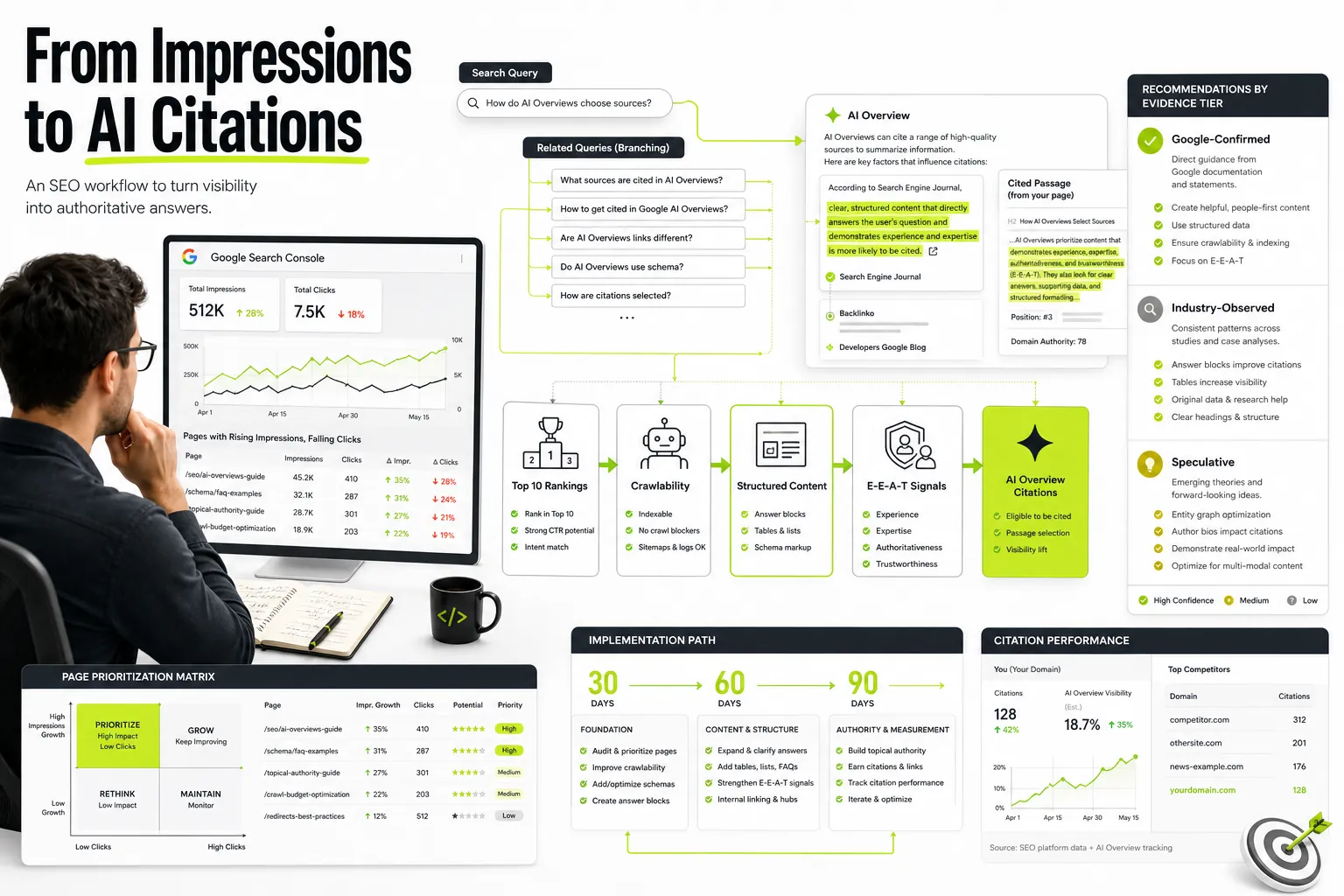
Google AI Overviews (formerly SGE) represent the most significant shift in search user experience since the introduction of the Knowledge Graph. Rather than simply returning ten blue links, Google’s generative layer synthesizes answers directly on the search engine results page (SERP), drawing context, figures, and recommendations from a selected group of web sources.
For search engine marketers, content strategists, and growth teams, this shift presents a clear challenge: traditional click-through rates (CTR) on top-ranking queries are compressing, while impression counts in Google Search Console (GSC) remain high or even increase. Learning how to rank in google ai overviews requires moving past speculative tactics and focusing on how generative engines actually index, retrieve, and synthesize web content.
This guide outlines a data-backed, GSC-first framework for securing citations in Google AI Overviews. Grounded in search architecture, verified empirical studies, and Google’s official documentation, this playbook eliminates the noise and delivers actionable steps to audit, optimize, and measure your performance.
How Google AI Overviews Work: RAG, Query Fan-Out, and Citation Mechanics
To optimize content for Google AI Overviews, you must first understand the technical pipeline that generates them. AI Overviews do not rely on an LLM reading the live web in real time from scratch, nor do they rely entirely on pre-trained parametric memory. Instead, Google uses a multi-stage retrieval system.
      [ User Query ]
      │
      ▼
[ Query Fan-Out Engine ] ──► Generates 3-5 sub-queries
      │
      ▼
[ Traditional Index Retrieval ] ──► Identifies candidate passages (Top 10 + Niche Experts)
      │
      ▼
[ RAG & Verification Layer ] ──► Fact-checks against grounded search data
      │
      ▼
[ AI Overview & Citations ]
The RAG Architecture Behind AI Overview Generation
Google AI Overviews rely on Retrieval-Augmented Generation (RAG). When a user submits a query, Google’s system retrieves relevant passages from its traditional search index first. These retrieved passages are passed into the generative model as context, forcing the model to ground its response in real web documents rather than hallucinating facts.
The generation process follows three core steps:
- Retrieval: The system queries the index to identify high-trust passages related to the user prompt.
- Synthesis: The LLM summarizes and merges the retrieved information into a cohesive, natural-language overview.
- Attribution: The system maps generated claims back to the underlying source URLs, creating the link cards and inline citations displayed to the user.
Understanding this process is critical: if your content is not retrieved during the initial search phase, it cannot be cited in the final overview. For an in-depth operational walkthrough on schema, source trust, and citation mechanics across LLM surfaces, read our operational guide on grounding AI for SEO with first-party search data .
Understanding Query Fan-Out and Multi-Source Synthesis
Complex search queries rarely trigger a single lookup. Instead, Google uses Query Fan-Out—a process where the primary search term is decomposed into multiple implicit sub-queries.
For example, if a user searches for “best enterprise CRM for remote sales teams,” the fan-out engine breaks this query down into sub-queries such as:
- “enterprise CRM security features remote access”
- “CRM mobile app integration usability”
- “enterprise CRM pricing remote licensing models”
Google executes these sub-queries simultaneously across its index. The AI Overview then synthesizes the results from these distinct searches into a single panel. Content that comprehensively answers both the broad head term and specific sub-queries is significantly more likely to earn citation cards across multiple sections of the overview panel. To better understand how conversational search interfaces handle this differently than SERP overviews, review our analysis on how Google AI Mode differs from AI Overviews .
The 76% Ranking Overlap: Why Traditional Top 10 Search Still Matters
Evidence Grade: Google-Confirmed & Industry-Observed
A persistent myth in generative search optimization is that AI Overviews pull randomly from obscure corners of the web, bypassing organic rankings entirely. Empirical data refutes this claim. Multiple industry studies tracking millions of AI Overview responses show a ~76% overlap between cited domain links and pages ranking in the traditional organic Top 10 for the primary query or its fan-out sub-queries.
| Citation Source Category | Percentage of Total Citations | Primary Optimization Focus |
|---|---|---|
| Organic Top 10 Results | ~76% | Core organic SEO, authority, traditional ranking signals |
| Deep Niche / Specific Passages | ~24% | Passage-level answer formatting, deep information gain, specific technical tables |
This high correlation proves that traditional organic search performance remains the primary gateway to AI Overview citations. However, the remaining ~24% of citations come from pages outside the top 10 that offer hyper-specific, passage-level answers to fan-out sub-queries. The target strategy is clear: maintain strong fundamental organic rankings while optimizing page structure for direct passage extraction.
Core SEO Strategies for AI Search Engines and Generative Discovery
Adapting your content strategy for generative engines requires balancing core technical search principles with structured formatting. Applying effective seo for ai search engines involves refining your existing organic foundation to make content easily parseable by RAG retrieval systems.
The Five Foundational Pillars: Crawlability, Relevance, Authority, Usefulness, and Measurement
Google’s AI generation pipeline relies heavily on the foundational framework of modern web search. At Dango, we structure generative optimization around five core pillars:
- Crawlability: Ensuring search bots can access, render, and extract page content without JavaScript blocking or restrictive crawler directives.
- Relevance: Aligning page topics precisely with query intent, using natural semantic language and explicit structural headers.
- Authority: Building site-level trust through backlink profiles, brand mentions, and subject-matter expertise.
- Usefulness: Designing layouts that serve human readers quickly—placing actionable answers directly upfront rather than hiding them behind fluff.
- Measurement: Tracking GSC impression shifts, query-level position drift, and click-through dynamics to isolate generative impact.
To explore how these pillars operate as a complete site audit framework, read our full guide on foundational SEO pillars that underpin AI search visibility .
Establishing E-E-A-T and Site-Level Trust Signals
Google relies on Experience, Expertise, Authoritativeness, and Trustworthiness (E-E-A-T) to filter out unverified content from AI Overviews, particularly on Your Money Your Life (YMYL) topics. Generative models prioritize grounded sources with verified trust profiles.
To reinforce site-level E-E-A-T:
- Explicit Author Byline & Credentials: Clear, linked author profiles detailing real-world experience, credentials, and published work.
- Transparent Editorial Policies: Clear documentation regarding how content is reviewed, fact-checked, and updated.
- First-Party Citation & Sourcing: Citing reputable primary research, government data, academic publications, or official documentation within your content.
Building Information Gain to Stand Out in Training Datasets
Generative AI models are trained on massive text corpora. If your article simply rephrases the top three ranking results, it offers zero net new value to a RAG pipeline. RAG retrieval algorithms explicitly favor content that provides high Information Gain—unique data points, novel insights, original quotes, or concrete statistics not found on competing pages.
To increase your page’s Information Gain score:
- Include proprietary benchmark data or customer survey results.
- Provide original step-by-step walkthroughs with unique screenshots.
- Share specific implementation details, trade-offs, and concrete edge cases.
Content Structuring for Maximum AI Overview Citability
AI models extract passages, not full articles. To maximize citability, structure your pages into clean, modular blocks that can be easily parsed and re-assembled by an LLM.
Crafting Direct Answer Blocks and Concise Definition Statements
When Google processes a query, it searches for target passages that answer the core question directly. You should include clear, direct Answer Blocks immediately below H2 or H3 question headers.
An ideal Answer Block follows these specifications:
- Length: 40–60 words.
- Placement: Immediately following the heading.
- Tone: Declarative, factual, and objective.
- Syntax: Lead with a clear target statement (e.g., “[Topic] is [definition]…”).
      <h2>What is Retrieval-Augmented Generation?</h2>
<p>
  Retrieval-Augmented Generation (RAG) is an AI architecture that enhances
  large language model responses by retrieving verified facts from an external
  knowledge base or search index before generating an answer. This process
  improves factual accuracy and provides direct attribution to source documents.
</p>
Optimizing Header Hierarchy, Tables, and Bulleted Lists
Non-linear data representation helps LLM parsers categorize and extract relationships quickly.
- Strict H2/H3/H4 Hierarchy: Do not skip heading levels. Use descriptive, semantically clear headers that include query-relevant nouns.
- Data Tables: Format complex multi-variable comparisons using clean HTML or Markdown tables. AI Overviews frequently lift entire table blocks directly into SERP citation panels.
- Unordered & Ordered Lists: Use lists for step-by-step processes, feature summaries, or itemized criteria. Ensure each list item begins with a bolded term or phrase for quick semantic parsing.
Designing Content for Passage-Level Extraction
Google uses Passage Ranking technology to evaluate specific sections of a page independently. A paragraph located deep on a page can earn an AI Overview citation even if the overall page targets a slightly broader topic.
To optimize for passage extraction:
- Keep paragraphs focused on a single concept (3–4 sentences maximum).
- Avoid vague pronoun references (e.g., “This is because it handles that…”). Use explicit nouns (e.g., “Query fan-out improves citation accuracy because…”).
- Make each section self-contained so it retains full context if read entirely in isolation.
Technical SEO, Schema Markup, and Crawler Visibility Controls
Technical SEO provides the infrastructure that allows search bots to discover, index, and parse your content efficiently.
Confirmed Schema Types: Article, Organization, BreadcrumbList, and WebPage
Evidence Grade: Google-Confirmed
Structured data helps search engines map entities and understand site architecture. Google has explicitly confirmed support for standard semantic schemas that assist with content parsing:
-
Article/TechArticle/NewsArticle: Defines publication date, author attribution, headline, and publisher. -
Organization: Establishes brand entity identity, official logos, social profiles, and domain ownership. -
BreadcrumbList: Clarifies URL taxonomy and topic relationships. -
WebPage: Outlines main entities and page context.
Debunking Schema Overhype: The Real Role of FAQ and HowTo Markup
Evidence Grade: Myth / Overhyped
There is a common misconception that adding FAQPage or HowTo schema markup will automatically force Google to display your content inside an AI Overview.
In reality, Google has significantly scaled back standard SERP rich results for FAQPage and HowTo markup across desktop and mobile. While structured data helps Google understand context, AI Overviews rely primarily on natural language processing (NLP) and vector extraction from raw text rather than JSON-LD markup blocks. Relying solely on schema without high-quality natural language text will not yield AI Overview citations.
Managing Crawlers with Preview Controls, nosnippet, and Google-Extended
Site owners frequently ask how control directives impact generative display. It is critical to differentiate between search indexing controls and model training controls:
                        ┌── Googlebot (Search Indexing) ──► Controls AI Overviews
Crawler Control ──┤
                  └── Google-Extended (Training) ──► Controls Gemini Model Training
-
nosnippet: Blocking snippet generation completely removes your content from traditional search snippets and AI Overviews. Do not use this if you want to rank in AI Overviews. -
max-snippet:[number]: Setting this tag limits the character count Google can extract. If set too low (e.g.,max-snippet:50), Google may be unable to parse enough context to form an AI citation card. -
Google-Extended: This User-Agent directive allows site owners to opt out of having their content used for training Google’s foundational AI models (such as Gemini). BlockingGoogle-Extendeddoes NOT prevent your site from appearing in AI Overviews. AI Overviews rely on standardGooglebotindex retrieval.
Off-Page Signals: Topical Authority, Brand Mentions, and Surround-Sound SEO
Off-page signals demonstrate to Google that your brand is a trusted authority across a given topic cluster.
Why Pages Covering Fan-Out Sub-Queries Earn 161% More Citations
Evidence Grade: Industry-Observed
Domains that build deep, interconnected content hubs around a subject consistently outperform shallow sites in generative search. Data indicates that sites covering an entire sub-query network earn up to 161% more AI Overview citations than sites with isolated single articles.
When Google executes query fan-out, it looks for domain-level topical authority. If your site has detailed articles addressing each sub-topic in the cluster, Google’s system assigns higher trust weights to your primary page.
Leveraging Brand Mentions and Entity Recognition Across Third-Party Sites
Generative models evaluate web-wide entity associations. If industry publications, software comparison directories, review aggregators, and news sites consistently associate your brand name with a specific product category or solution, Google builds a strong entity graph relationship.
This “Surround-Sound SEO” strategy involves:
- Securing unlinked and linked brand mentions across authoritative niche sites.
- Maintaining accurate profiles on industry platforms (e.g., G2, Capterra, Crunchbase).
- Earning inclusions in third-party listicles and roundups that rank for high-intent head queries.
Diagnosing AI Overview Impact with Google Search Console
Google Search Console does not currently provide an explicit filter tag for “AI Overview Clicks” versus “Standard Organic Clicks.” However, you can accurately diagnose AI Overview impact using existing performance data.
Identifying Impressions-Up and Clicks-Down Trajectories
When an AI Overview triggers for a keyword where your page ranks organic position #1 to #3, user behavior changes:
- Impressions remain flat or rise: Your URL is returned in the underlying search results or rendered inside an AI Overview citation card.
- Clicks drop: Users find their answer directly within the generated summary without clicking out to any domain.
- CTR decays: Your click-through rate experiences a sharp decline despite stable or improving average position metrics.
      GSC Metrics Trend (AI Overview Takeover):
Impressions: ───────────────────────► [Stable or Increasing]
Avg Position: ──────────────────────► [Stable #1 - #3]
CTR:         ──────────────────────► [Sharp Decline]
If you observe this pattern for a high-volume query, an AI Overview has likely taken over the primary SERP visual space.
Segmenting CTR Decay Across High-Intent Query Classes
To systematically analyze this impact, segment your GSC data by query intent:
- Informational Queries (“how to calculate churn rate”): High risk of CTR decay. AI Overviews synthesize simple definitions and formulas completely, reducing click-throughs.
- Investigational Queries (“dango vs standard seo tools”): Moderate CTR decay. Users often click citation cards to verify detailed feature comparisons or workflows.
- Transactional Queries (“buy enterprise seo software”): Low AI Overview triggering rate. Users require live pricing, product demos, and checkout flows.
Focus your AI Overview optimization efforts on investigational and high-value informational queries where citations drive qualified traffic.
Measuring Citations and Google AI Mode Tracking Strategies
Because traditional rank tracking tools can miss generative elements, implementing reliable google ai mode tracking requires combining GSC data with specialized generative tracking platforms.
Evaluating Free and Paid Citation Tracking Methodologies
To effectively track generative visibility, teams combine first-party performance logs with specialized SERP scraping platforms:
- First-Party GSC Query/Page Export (Free): Export daily performance data via GSC API or BigQuery. Run script-based detection on pages experiencing CTR drop with high impression stability.
- Generative SERP Tracking Platforms (Paid): Specialized tracking tools monitor AI Overview presence, citation share, and link position across custom keyword sets.
To evaluate tools for tracking generative search visibility, read our guide on AI Mode SEO tracking software and evaluation criteria .
Distinguishing AI Overview Citations from Conversational AI Mode Traffic
It is important to keep AI Overviews distinct from conversational AI interfaces:
- AI Overviews: Automatically generated panels displayed directly on the primary Google Search results page.
- AI Mode / Conversational Tabs: Dedicated interactive search environments where users engage in multi-turn dialogues.
AI Overview traffic appears inside standard Google organic referrer channels (google.com). Tracking dedicated conversational traffic requires inspecting secondary referrer patterns and specific UTM parameters if tracking custom links.
Key Performance Indicators Beyond Organic Rank Position
Tracking average rank position alone is no longer sufficient. Instead, track these four core KPIs:
- Citation Share of Voice: The percentage of AI Overviews in your keyword set that cite your domain.
- Citation Position: Whether your URL is displayed in the primary visible card carousel or hidden inside an expanded accordion menu.
- Brand Sentiment Score: Whether the generative overview describes your product, brand, or method favorably.
- Grounded Impression Value: Impression volume earned specifically on long-tail fan-out queries.
Debunking Common AI Search Myths and Chasing Tracker Metrics
As search evolves, speculative and inaccurate advice proliferates. Let’s isolate fact from fiction.
Myth vs. Reality: No Secret Markup or llms.txt Requirements
- Myth 1: You must create an
llms.txtfile to rank in Google AI Overviews.- Reality:
llms.txtis an informal community proposal for organizing markdown content for LLMs. Google AI Overviews use standardGooglebotindexing and completely ignorellms.txtfiles for SERP generation.
- Reality:
- Myth 2: There is a hidden meta tag that guarantees AI Overview inclusion.
- Reality: Google has repeatedly confirmed that no special code or meta tag guarantees AI Overview inclusion. Citation is governed by standard indexing, ranking algorithms, and RAG relevancy.
- Myth 3: AI Overviews write answers entirely from LLM memory.
- Reality: AI Overviews are dynamically grounded in live web index documents retrieved via RAG at query time.
Why Chasing Daily Citation Fluctuation Wastes SEO Resources
Generative outputs are non-deterministic. Running the exact same query three times in a single day can yield subtle variations in overview text and citation cards.
Attempting to react to daily citation shifts leads to over-optimization and unnecessary code changes. Focus on broader 30-day trends across query clusters rather than reacting to single-day fluctuation.
30/60/90-Day Implementation Timeline
To systematically roll out these optimizations across your site, prioritize high-impact pages using a structured framework.
Phase 1: Diagnostic GSC Audit and Quick-Win Optimizations (Days 1–30)
- Week 1: Export 90 days of GSC performance data. Filter for pages with high impression counts (>5,000/mo) but declining CTR.
- Week 2: Perform manual SERP audits on top 20 priority queries to verify AI Overview presence.
- Week 3: Add explicit 40–60 word Answer Blocks directly under H2 headers for Priority 1 pages.
- Week 4: Audit technical crawler directives (
max-snippet,robots.txt) to ensure unhindered extraction.
Phase 2: Technical QA, Structured Formatting, and Information Gain (Days 31–60)
- Week 5: Convert messy text blocks into clean HTML/Markdown comparison tables and bulleted lists.
- Week 6: Inject original primary data, proprietary survey metrics, or step-by-step screenshots to boost Information Gain.
- Week 7: Validate
Article,Organization, andBreadcrumbListschema implementation across all target URLs. - Week 8: Review and update author credentials, bylines, and external primary reference links to solidify E-E-A-T.
Phase 3: Topical Expansion, Entity Building, and Tracking (Days 61–90)
- Week 9: Analyze fan-out sub-queries for primary terms; publish dedicated sub-topic articles to complete topical hubs.
- Week 10: Implement cross-linking between hub pages and sub-topic articles using contextually explicit anchors.
- Week 11: Execute digital PR and off-page outreach to build brand entity mentions on key third-party platforms.
- Week 12: Set up recurring citation tracking dashboards to measure long-term Citation Share of Voice and impression growth.
Streamlining Search Console Workflows with Dango
Executing a GSC-first strategy manually across hundreds of URLs requires significant engineering and analytical overhead. Dango simplifies this process by connecting directly to your Google Search Console account.
Instead of relying on third-party volume estimates, Dango turns your first-party search data—impressions, positions, and CTR patterns—into structured keyword clusters, actionable content briefs, and optimization workflows. By analyzing actual search impression data, Dango identifies exact query fan-out gaps and structural opportunities to help you build and maintain citable content at scale.
Ready to turn your search data into generative visibility? Get started with Dango today.
Frequently Asked Questions
How do Google AI Overviews differ from Google AI Mode?
Google AI Overviews are automatically generated summary panels integrated directly into the standard search results page. Google AI Mode refers to dedicated conversational search environments that allow multi-turn dialogue. AI Overviews rely on direct RAG extraction from the search index, whereas conversational tabs support deeper, multi-step user prompts.
Do you need special schema markup or code to rank in AI Overviews?
No. Google has explicitly confirmed that no special schema markup or meta tag is required to rank in or be cited by AI Overviews. While standard structured data like Article and Organization helps Google parse entities, AI Overviews rely primarily on standard Googlebot index retrieval and natural language processing.
Does ranking position #1 in organic search guarantee an AI Overview citation?
No. While there is a ~76% overlap between AI Overview citations and traditional Top 10 organic results, holding position #1 does not guarantee a citation. If your page lacks concise answer blocks or fails to address specific fan-out sub-queries, the generative engine may cite lower-ranking pages that offer better passage-level structure.
Why is my traffic decreasing even though impressions in Search Console are rising?
This pattern typically occurs when an AI Overview takes over the visual SERP for your target keywords. When Google displays a direct synthesized answer at the top of the page, users read the information on the SERP without clicking out to external links. This keeps impression metrics stable or growing while organic click-through rates decline.
Does blocking Google-Extended prevent my site from being cited in AI Overviews?
No. The Google-Extended User-Agent directive controls whether your content is used to train Google’s foundational AI models like Gemini. AI Overviews rely on standard Googlebot indexing. Blocking Google-Extended will not remove your site from Google Search or prevent it from appearing in AI Overviews.
How long does it take for Google to cite updated content in an AI Overview?
Once Googlebot recrawls and reindexes an updated page, changes can reflect in AI Overviews within a few days to a couple of weeks. However, because generative outputs are calculated at query time based on multi-source synthesis, citation updates depend on how quickly Google recalculates passage relevancy across the entire query fan-out cluster.